
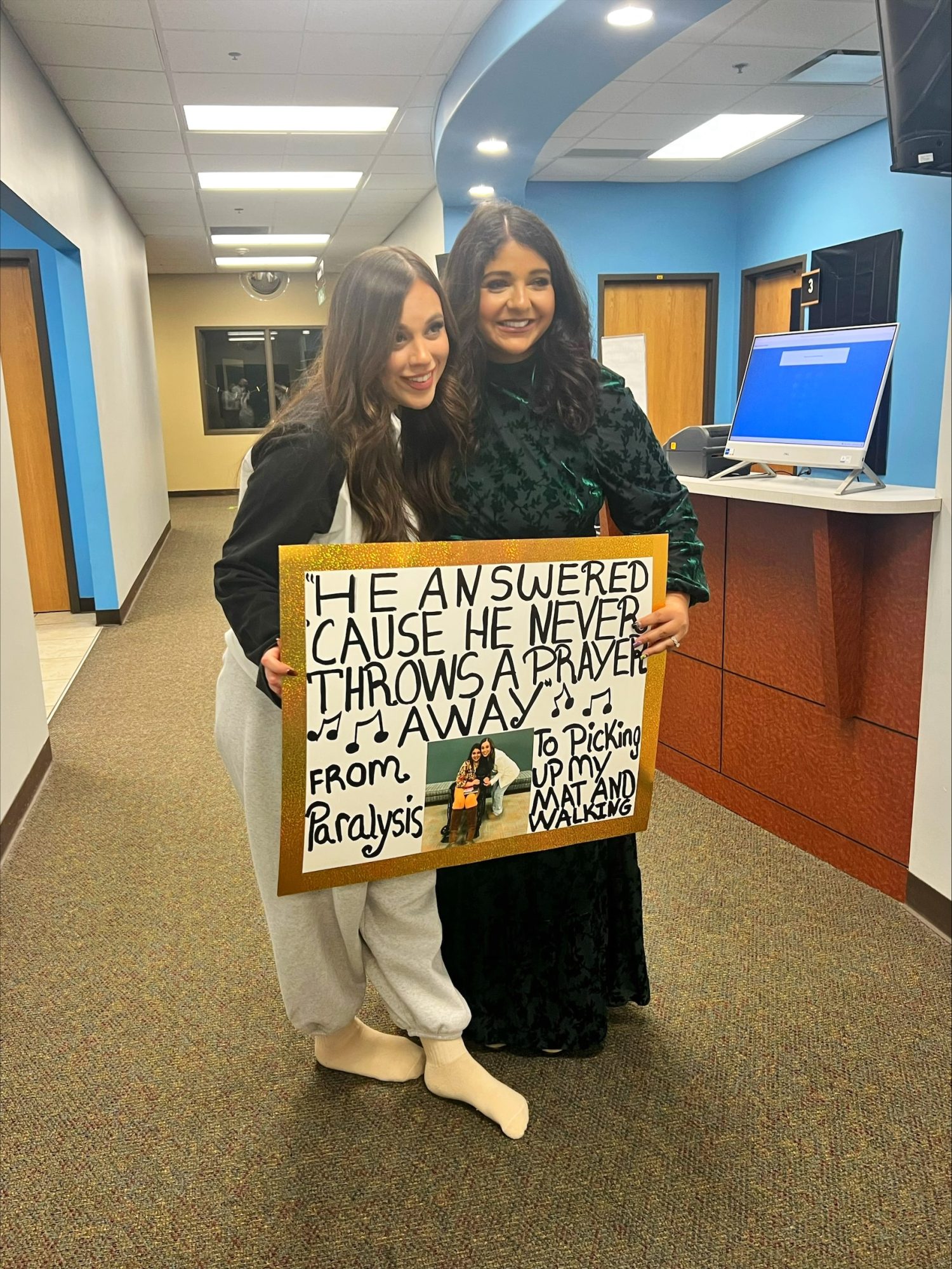
Alyssa Lyon’s experience with functional neurological disorder has been a journey of seeking answers and finding hope. Her condition reached debilitating stages during that journey, but UAB Medicine’s Interdisciplinary Functional Neurological Disorder Treatment Program helped her regain strength, confidence, and independence in everyday life.
Based on her experience, she adopted a personal mission of awareness and patient advocacy. But she couldn’t see that future five years ago.
“In 2021, my health began changing in ways I couldn’t explain,” said Lyon, 33, a resident of Huntsville, Ala., as she recalled the odd physical symptoms and seizures she was experiencing. Her remark is an understatement of the full impact that functional neurological disorder (FND) can have.
About FND
FND is a condition in which altered communication from the brain makes the body function abnormally. It can cause seizure-like symptoms, shaking, paralysis, difficulty walking, and other neurological issues.
Patients with FND often feel that they have no control of their movements or actions, like their body is no longer “their own.” In turn, they may experience strong emotions and show behaviors that are either caused by stress from the physical symptoms of FND or a direct result of the altered brain signals.
Because FND is an issue of the brain failing as a complex system of communications – rather than a flaw in the structure of the brain itself – the condition is difficult to diagnose and treat. In Lyon’s case, her symptoms were extreme.
“While I was incredibly grateful for all the care I received early on, I knew that I wasn’t getting answers that I desperately needed,” Lyon said. “For four years I dealt with the seizures, but test upon test kept coming back as normal. While most people would take that as good news, for me, ‘normal’ became one of the most heartbreaking things I could hear. I even went as far as wondering if I was imagining all this. It was incredibly isolating to experience real symptoms while every test said nothing was wrong.”
Desperately seeking answers
Lyon’s doctors recommended that she have more tests done at The Kirklin Clinic of UAB Hospital. In May 2024, a neurological medical team guided by Hernan Esquivel, M.D., ruled out epilepsy as a cause of the seizures, and eventually she was diagnosed with FND.
“My husband and I had just gotten married,” Lyon said. “That occasion, and then finally getting a diagnosis confirming that what I was experiencing was real and not in my head, brought such happiness. The diagnosis gave a name to what I had been fighting for five years.”
She next met with UAB Medicine health service psychologist Melissa Greenfield, PsyD.
“I was discharged, headed back home to Huntsville with a treatment plan, and was scheduled for telehealth appointments with Dr. Greenfield to learn how to control my seizures and symptoms with therapy,” Lyon said, referring to Retraining and Control Therapy, or ReACT. “Months went by, and it seemed like I was improving.”
An overnight change
Nearly a year later, in March 2025, Lyon says her life changed overnight.
“I woke up to get ready for work, tried to sit up in bed, and became aware that I had no feeling from my waist down to my toes,” she recalled. “I tried massaging my legs thinking they were just asleep, but I realized that something was wrong when I could not sit up in bed. I called my husband, trying my best not to panic. We made a few phone calls and were advised to go to the ER.”
Lyon eventually began receiving rehabilitation care as an inpatient at a North Alabama hospital. She says the team there became her second family. However, despite working diligently each day toward recovery, Lyon had a severe seizure that caused full-body paralysis. She couldn’t move or talk. And she wasn’t eating, because FND had affected the muscles in and around her throat. Lyon slowly regained some upper body movement, but improvement at that point did not represent any significant recovery.
“What we didn’t know during my nearly two-month stay in rehab was that the therapy I was doing was making me worse,” Lyon said. “We all learned together as a team that we did not have the correct therapy plan. My medical team learned of UAB Medicine’s Interdisciplinary Functional Neurological Disorder Treatment Program. After careful consideration and some meetings, it was decided that this was where I needed to go.”
Unfortunately, the good news of a new treatment plan was followed by bad. While waiting to make the move to UAB, Lyon suddenly lost cognitive and memory function the day before discharge.
“My speech was gone, and my declining state of my mind was severe at this point,” she said. “I was unrecognizable. I lost my sense of self, memory of my husband, and any awareness of my condition. This was the worst stage of FND for me.”
Finding hope again
At that point, Lyon met with UAB Medicine Outpatient Rehabilitation Services physical therapist Mark Hjelmeland, PT, DPT, to discuss other possible FND treatments.
“I don’t remember many details of that outpatient therapy appointment due to my state of mind,” Lyon said. “But I certainly recall physical therapist Mark Hjelmeland sitting down directly in front of me and calmly introducing himself with, ‘Hi Alyssa, my name is Mark.’ He talked with me for nearly 30 minutes, after which he made three statements that are forever planted in my mind: ‘This does not have to be your forever. Change can happen. Recovery can happen.’ I instantly felt a weight leave my shoulders and found hope again.”
Along with hope, what Lyon found at UAB Medicine was a care team that would lead her through complex and varied regimens that combined physical rehabilitation, psychological support, and specific mental strategies to improve function and reduce, remove, or even “work around” FND symptoms.
Automatic response retraining
A key part of this treatment, known as automatic response retraining, involves developing opposing responses to the involuntary ones caused by FND. This approach is a steady, often difficult process of retraining the entire neurological system to correctly communicate information needed for standing, walking, limb movement, speech, and the crucial coordination of those and other basic functions.
Speech therapy enabled Lyon to reconnect communication networks needed for speech, recognizing words, and establishing natural speaking patterns and rhythms. Pool therapy provided a weightless environment for relearning body awareness, balance, weight-shifting, and walking patterns.
Much of the recovery process was a matter of Lyon convincing herself that she was safe from falling, capable of speaking, and was, overall, still in charge of her body. Making that argument to herself was especially difficult, because her earlier experience with paralysis left a false but lingering notion that almost any movement was somehow “dangerous.”
Lyon recalls that distractions helped unlock movement. While walking, she would have conversations, count forward and backward, catch a ball, focus on a rhythm or metronome, or complete obstacle courses. Out of all the tools used in her recovery, Lyon believes that music was the most powerful.
“Humming to music helped bring back my speech and became much more than encouragement,” she said. “It became my therapeutic tool. One of the most powerful parts of my recovery was learning that singing often came more easily than speaking. It was explained to me that singing engages broader brain networks involving rhythm, melody, timing, and emotion.”
A purpose beyond diagnosis
“It sounds odd, but a major issue with FND is that you have to trick your body into being brave, because there’s a sense it has a mind of its own,” Lyon said. “Of course there is only one mind at work here, and FND is just a case of the body either not correctly hearing anything that the mind has to say or hearing some things it should not say. The positive side is that, as my confidence grew, my brain gradually stopped triggering all those protective responses. I learned that repeating those successful movements over and over strengthens neural pathways. But looking back, I know that even this difficult and complicated therapy was not the hardest part of my journey.”
Lyon is referring to an aspect of FND that can’t be easily challenged solely in the clinical setting: not knowing.
“Before I got a correct diagnosis of FND and then got a correct treatment plan, living in the uncertainty of an undiagnosed illness for five years slowly wore me down,” Lyon said. “Hope was harder to hang on to. It doesn’t have to be that way for others. My goal is not just to share my story but also to transform it into a platform that inspires change. I want to contribute to a future where patients feel believed, supported, and equipped with the resources they need from the very beginning – not years after symptoms begin.”
Lyon says she’s passionate about her mission to raise awareness of FND by sharing her experience through speaking engagements, healthcare education, community events, podcasts, media opportunities, and patient and family advocacy.
“I am deeply grateful to everyone at the FND Clinic at UAB for their compassion, patience, and never-ending encouragement,” Lyon said. “And for celebrating the small victories that they knew, before I did, would lead to my biggest victories. I thank them for helping me reclaim my life and giving me a purpose far beyond my diagnosis. If sharing my story helps one patient find hope, then every challenge and battle I faced will have served that greater purpose.”
Learn more about UAB Medicine’s Interdisciplinary Functional Neurological Disorder Treatment Program.